Category: Uncategorized

  • Data Center Switching Architecture: Designing for High Availability and AI Workloads

    Data Center Switching Architecture: Designing for High Availability and AI Workloads

    The traditional three-tier network is no longer a viable foundation for the modern enterprise; it’s a bottleneck that actively degrades high-performance compute clusters. As we move through 2026, the demands of AI workloads have exposed the inherent limitations of legacy data center switching architecture. You’ve likely seen how unpredictable latency and oversubscription ratios can throttle GPU performance, turning a significant infrastructure investment into a source of operational friction. We understand that maintaining stability while integrating disruptive technology requires more than just hardware upgrades. It demands a fundamental shift in how we engineer traffic flow.

    This guide provides a technical blueprint for transitioning from rigid hierarchies to non-blocking, AI-ready fabrics. You’ll master the mechanics of Spine-Leaf designs and the implementation of BGP-EVPN VXLAN to ensure deterministic performance across your entire environment. We’ll examine how to build resilient, sovereign systems that prioritize structural integrity and local accountability. This ensures your networking stack remains a strategic asset rather than a liability in an increasingly complex digital landscape. By moving beyond legacy constraints, you can establish a network that supports both current operations and the future of automated intelligence.

    Key Takeaways

    • Understand why the transition from legacy 3-tier models to modern fabrics is mandatory for managing the surge in east-west server traffic.
    • Discover how a Spine-Leaf data center switching architecture provides the non-blocking performance and predictable latency required for high-density environments.
    • Identify the specific networking requirements for AI workloads; including the use of RoCE to reduce CPU overhead in GPU clusters.
    • Establish a blueprint for enterprise resilience by implementing high availability and micro-segmentation to minimize operational blast radiuses.
    • Master the advantages of vendor-independent, Swiss-engineered solutions that prioritize direct accountability over global offshore models.

    Table of Contents

    Evolution of Data Center Switching: From Legacy 3-Tier to Modern Fabrics

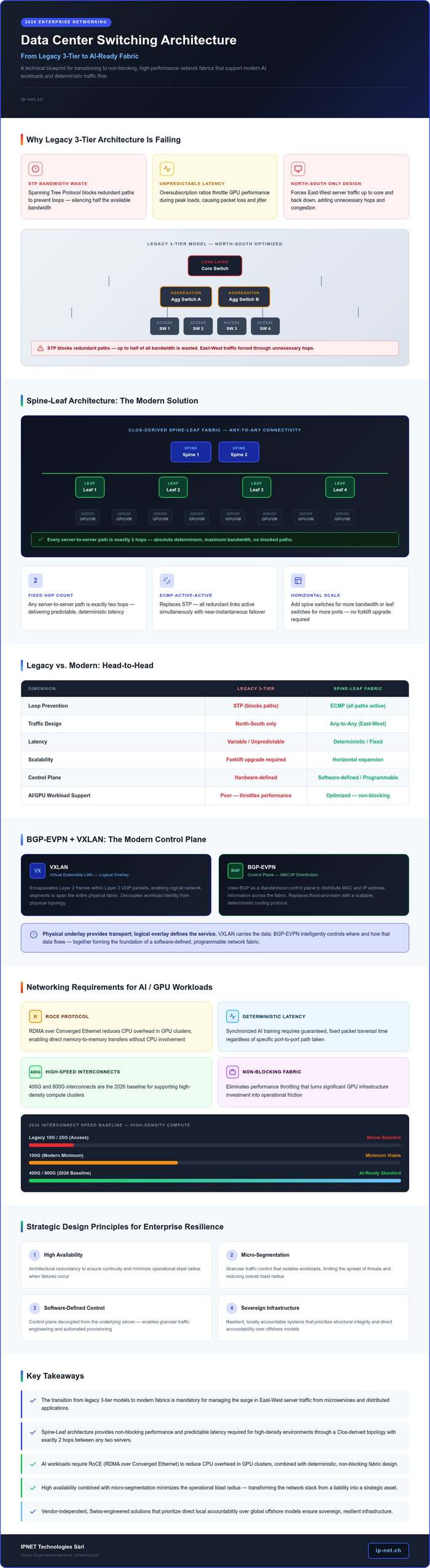
    For decades, the hierarchical three-tier model served as the gold standard for enterprise networking. This structure organized hardware into distinct Access, Aggregation, and Core layers; a design optimized for North-South traffic where data primarily flowed between external clients and internal servers. In this environment, the Spanning Tree Protocol (STP) acted as the primary mechanism for loop prevention. However, STP functions by intentionally blocking redundant paths, which effectively silences half of the available bandwidth. This waste of resources is no longer acceptable in a 2026 data center switching architecture where efficiency and throughput are paramount.

    The fundamental nature of data movement has changed. Modern applications rely on distributed microservices and clustered databases that generate massive volumes of East-West traffic. This server-to-server communication bypasses the logic of hierarchical models, often forcing data to travel up to the core and back down again, creating unnecessary latency and congestion. To address this, the industry has shifted toward non-blocking fabrics that provide high-bandwidth, any-to-any connectivity.

    The Decline of the Hierarchical Model

    Legacy 3-tier architectures struggle with oversubscription ratios that throttle performance during peak loads. When too many servers at the Access layer compete for limited uplinks to the Aggregation layer, packet loss and jitter become inevitable. The rise of virtualization and containerized environments has exacerbated this issue, as workloads move dynamically across the physical footprint. This volatility demands a network that offers absolute determinism. In the context of modern switching, determinism is the guarantee that data packets will traverse the network with a fixed, predictable latency regardless of the specific port-to-port path taken. Without this predictability, synchronized AI training and high-frequency financial transactions fail to meet their performance benchmarks.

    Defining the Modern Network Fabric

    A modern network fabric replaces rigid hierarchies with a flatter, more agile topology. Modern architects favor the fat-tree network topology to eliminate the bottlenecks inherent in older designs, ensuring that every server is equidistant from every other server. This approach prioritizes three core characteristics: scalability, agility, and resilience. By 2026, the integration of 400G and 800G interconnects has become the baseline for supporting high-density compute clusters. We’ve moved beyond hardware-defined limitations toward software-defined switching, where the control plane is decoupled from the underlying silicon. This transition allows for granular traffic engineering and automated provisioning, transforming the data center switching architecture from a static utility into a dynamic, programmable asset that responds to real-time workload demands.

    Spine-Leaf Architecture: Achieving Non-Blocking Performance

    Every leaf switch in a spine-leaf topology connects directly to every spine switch, creating a high-performance fabric that eliminates the “choke points” of legacy designs. This ensures that any server-to-server path is exactly two hops away, delivering the absolute determinism required for modern workloads. By utilizing a data center switching architecture based on this Clos-derived topology, organizations eliminate the variable latency that plagues legacy systems. This physical layout provides a foundation where bandwidth is never sacrificed for loop prevention.

    The most significant operational shift in this model is the total replacement of Spanning Tree Protocol (STP) with Equal-Cost Multi-Path (ECMP) routing. While STP deactivates redundant links to prevent loops, ECMP leverages every available connection simultaneously. This active-active load balancing maximizes total fabric bandwidth and provides near-instantaneous failover. Scalability becomes a matter of horizontal expansion. You can increase total bisectional bandwidth by adding spine switches or expand port density by adding leaf switches without disrupting existing traffic or requiring a complete forklift upgrade of the core.

    BGP-EVPN and VXLAN: The Modern Control Plane

    The physical underlay provides the transport, but the logical overlay defines the service. VXLAN (Virtual Extensible LAN) allows for the creation of Layer 2 virtual networks over a robust Layer 3 IP underlay, effectively extending the local network across the entire fabric without the limitations of traditional VLAN IDs. This encapsulation enables seamless workload mobility and multi-tenancy, allowing different business units or clients to coexist on the same physical hardware with complete isolation. To manage this complexity at scale, BGP-EVPN has emerged as the industry-standard control plane. It provides a unified method for discovering endpoints and distributing MAC and IP reachability information, which significantly reduces the reliance on inefficient flood-and-learn mechanisms that often plague larger environments.

    Vendor-Independent Fabric Design

    A resilient data center switching architecture must prioritize open standards to avoid the strategic risk of proprietary lock-in. While some manufacturers push closed ecosystems, a vendor-independent approach allows architects to select the best silicon for specific use cases, whether that involves Broadcom’s high-throughput ASICs or specialized programmable chips. This flexibility ensures that your infrastructure remains interoperable with both legacy hardware and future technological shifts. It places the power of architectural choice back into the hands of the enterprise.

    When designing these complex environments, it’s essential to partner with experts who understand the nuances of Swiss-engineered reliability. Our team at IPNET Technologies Sàrl specializes in modern data center design that prioritizes structural integrity and long-term agility. We focus on outcome-oriented engineering that bridges the gap between current stability and future-ready performance.

    Architecting for AI: GPU Clusters and Low-Latency Switching

    AI training workloads, specifically those involving Large Language Models (LLMs), introduce traffic patterns that traditional networks simply weren’t built to handle. Unlike standard web traffic, AI data flows are massive, synchronized, and incredibly bursty. During the “All-Reduce” phase of model training, thousands of GPUs must exchange gradients simultaneously. If the data center switching architecture can’t facilitate this exchange with near-zero jitter, the entire compute cluster stalls. This synchronization makes the network the primary determinant of training efficiency; any delay in packet delivery translates directly into idle, expensive GPU cycles.

    To mitigate these bottlenecks, modern architects implement Remote Direct Memory Access over Converged Ethernet (RoCEv2). This protocol allows GPUs to access each other’s memory directly without involving the host CPU, which significantly reduces latency and processing overhead. However, RoCEv2 requires a “lossless” environment. Since standard Ethernet is lossy by design, we must implement Priority Flow Control (PFC) and Explicit Congestion Notification (ECN). These mechanisms prevent buffer overflows by pausing specific traffic classes before drops occur, ensuring the integrity of the AI data stream. Optimizing buffer management is equally critical; switches must balance shared buffer pools to absorb the intense micro-bursts characteristic of AI collective communication.

    GPU Interconnects vs. Traditional Switching

    The debate between InfiniBand and Ethernet for AI infrastructure has intensified as we head into 2026. While InfiniBand was historically the default for high-performance computing due to its native lossless nature, the emergence of the Ultra Ethernet Consortium (UEC) has made high-speed Ethernet a formidable competitor. Tail latency represents the delay experienced by the slowest packets in a flow; in synchronized AI training, this “long tail” determines the overall completion time because the entire GPU cluster must wait for the slowest member to finish its collective communication step. Choosing the right data center switching architecture involves weighing the turnkey performance of InfiniBand against the flexibility and multi-vendor ecosystem of Ethernet-based fabrics.

    MLOps Integration and Infrastructure Readiness

    Preparing a switching fabric for AI isn’t just about hardware; it’s about integration with the broader MLOps platform. A truly AI-ready network requires deep observability to detect “incast” congestion before it impacts model convergence. We focus on scaling compute and network resources in tandem to prevent GPU starvation, where expensive accelerators sit idle waiting for data. By implementing automated telemetry and AIOps-driven management, Swiss enterprises can ensure their infrastructure remains resilient under the unique pressures of machine learning at scale. This proactive approach transforms the network from a potential bottleneck into a high-speed highway for innovation.

    Strategic Design Principles for Enterprise Resilience

    Resilience in a modern data center switching architecture requires a move away from simple device redundancy toward holistic system durability. High Availability (HA) must be integrated at every layer; this includes redundant power supplies, supervisor modules, and multi-homed server connections. We design for “Blast Radius” reduction by leveraging micro-segmentation within the VXLAN overlay. This approach ensures that a security breach or a technical failure in one segment remains isolated, preventing lateral movement across the fabric. This structural isolation serves as the physical manifestation of Zero Trust security. It treats every connection as potentially compromised until verified by the control plane.

    Resilience Beyond Redundancy

    True resilience extends to the operational lifecycle. Active-Active data center designs require a switching fabric that supports seamless traffic failover across geographically dispersed sites without manual intervention. We prioritize mechanisms like In-Service Software Upgrades (ISSU) to allow for critical firmware updates without incurring downtime. To manage this complexity, we integrate AIOps-driven managed services that utilize real-time telemetry to identify anomalies before they manifest as outages. This proactive stance moves the organization from reactive firefighting to a state of managed stability. It’s about building a guardian for current operations while architecting for future growth.

    Network Automation and Orchestration

    Manual configuration is a primary source of enterprise risk. Modern operations utilize Infrastructure as Code (IaC) to ensure that every switch deployment is consistent, repeatable, and documented. By adopting a NetDevOps mindset, teams can treat network configurations like software; they use version control and automated pipelines for testing. Automated validation ensures that any change to the data center switching architecture is verified against the intended state before it’s pushed to production. This rigorous process spans from Day 0 design to Day 2 operations, reducing human error and accelerating the deployment of new services. It transforms the network into a programmable, reliable asset.

    For organizations seeking to modernize their core infrastructure, we provide expert Modern Data Center Design services that guarantee Swiss-engineered precision and direct accountability.

    Swiss-Engineered Excellence: The IPNET Advantage

    Modernizing a data center switching architecture requires more than just a procurement list of high-speed hardware. It demands a partner who understands the intersection of legacy stability and future-ready innovation. IPNET Technologies operates as a vendor-independent architect; we don’t answer to hardware manufacturers or follow proprietary agendas. Our focus remains solely on the structural integrity and performance outcomes of your specific environment. We prioritize Swiss accountability, ensuring that every design decision is backed by local expertise and a direct line of responsibility. We don’t utilize offshore hand-offs. Our engineers are rooted in the same regional precision that our clients expect from their mission-critical systems.

    Our end-to-end service model bridges the gap between high-level strategy and granular execution. We guide enterprises through the entire lifecycle of their networking stack, from initial technical audits to 24/7 managed operations. By incorporating AI readiness into every layer of the architecture, we ensure that your infrastructure isn’t just surviving current demands but is actively prepared for the surge in GPU-intensive workloads. This commitment to engineering excellence transforms the network from a cost center into a resilient, strategic asset.

    Vendor-Independent Technical Audits

    An objective assessment is the mandatory first step in any modernization journey. We conduct deep-dive technical audits to identify the specific bottlenecks in your current data center switching architecture, whether they stem from oversubscribed uplinks or inefficient spanning-tree configurations. Our audit process includes:

    • A comprehensive review of existing traffic patterns and latency benchmarks.
    • Identification of hardware limitations that prevent the adoption of modern fabrics.
    • The development of a strategic, phased roadmap for fabric migration.
    • Risk-mitigation planning to ensure zero-downtime transitions.

    This roadmap isn’t a generic template. It’s a customized engineering plan that respects your existing investments while providing a clear path toward a non-blocking, automated environment.

    Managed AIOps and Operational Stability

    Operational stability is the true measure of architectural success. Our managed services utilize AIOps to provide proactive monitoring and automated incident response, ensuring that your switching fabric maintains peak performance long after the initial deployment. We offer customized SLAs designed for mission-critical infrastructure, providing the peace of mind that comes with Swiss-based support. Our engineers act as a direct extension of your team, maintaining a constant vigil over your environment to prevent degradation before it impacts your business units. To begin your transition toward a more resilient network, schedule a vendor-independent infrastructure audit with our Swiss engineers. We’ll help you secure your current operations while building the foundation for your future AI initiatives.

    Securing the Future of High-Performance Infrastructure

    Modernizing your data center switching architecture isn’t merely a technical upgrade; it’s a strategic imperative for the AI era. We’ve explored the transition from legacy hierarchies to non-blocking spine-leaf fabrics, where determinism and predictable latency replace the bottlenecks of the past. For enterprises deploying GPU clusters, the shift toward lossless Ethernet and RoCEv2 is no longer optional. It’s the baseline for operational survival. You must prioritize structural integrity and micro-segmentation to ensure that your network remains a resilient foundation for innovation.

    At IPNET Technologies, we bring 20 years of infrastructure expertise to every engagement. We provide unbiased, vendor-independent advisory services rooted in Swiss-engineered reliability. Our engineers ensure that your transition to an AI-ready environment is seamless, secure, and directly accountable. Don’t let legacy constraints stifle your growth. Consult with our Swiss-based architects for an AI-ready network design. We’re ready to help you build a network that’s as ambitious as your business goals.

    Frequently Asked Questions

    What is the difference between Spine-Leaf and traditional 3-tier architecture?

    Spine-Leaf is a two-tier, non-blocking fabric designed for east-west traffic, whereas 3-tier is a hierarchical model optimized for north-south traffic. In a spine-leaf data center switching architecture, every leaf switch connects to every spine switch, ensuring equidistant paths and predictable latency. This eliminates the bottlenecks and spanning-tree limitations inherent in legacy hierarchical designs, providing the deterministic performance required for modern virtualized workloads and high-density compute clusters.

    How does BGP-EVPN VXLAN improve data center scalability?

    BGP-EVPN VXLAN decouples the logical overlay from the physical underlay, allowing for massive Layer 2 extension over a robust Layer 3 network. It uses BGP as a standards-based control plane to distribute reachability information, which effectively eliminates the inefficiency of traditional flood-and-learn mechanisms. This approach supports multi-tenancy and seamless workload mobility across thousands of endpoints. It provides a scalable framework that grows horizontally without the complex re-engineering required by legacy VLAN structures.

    What are the specific switching requirements for AI and GPU clusters?

    AI infrastructure requires high bisectional bandwidth, ultra-low latency, and zero packet loss. Because GPU clusters perform synchronized collective communication, any packet drop or jitter can cause GPU starvation and stall the entire training process. A robust data center switching architecture for AI must support 400G or 800G interconnects and implement lossless Ethernet protocols. These technical safeguards ensure that the network doesn’t become a bottleneck for expensive, high-performance compute resources.

    Can I implement a modern switching fabric using multiple hardware vendors?

    Yes, you can build a multi-vendor fabric by strictly adhering to open standards like BGP-EVPN and VXLAN. Vendor independence is a core strategic advantage that prevents proprietary lock-in and allows architects to select the best-of-breed hardware for specific performance tiers. Our engineering teams at IPNET specialize in designing these interoperable environments, ensuring that different silicon architectures communicate seamlessly. This approach provides long-term flexibility and better control over your infrastructure lifecycle.

    What is RDMA over Converged Ethernet (RoCE) and why does it matter for AI?

    RoCEv2 is a protocol that enables direct memory access between GPUs across an Ethernet network without involving the host CPU. This bypass significantly reduces latency and lowers CPU overhead, which is critical for the high-speed data exchanges required in AI training. However, RoCE requires a lossless environment to function correctly. This necessitates the implementation of Priority Flow Control (PFC) and Explicit Congestion Notification (ECN) within the fabric to prevent packet drops.

    How does network automation reduce operational costs in the data center?

    Network automation replaces error-prone manual configurations with Infrastructure as Code (IaC) and automated validation pipelines. By using a NetDevOps approach, enterprises can deploy consistent fabric configurations in minutes rather than days. This reduction in human error prevents costly outages and accelerates service delivery. Automation also simplifies Day 2 operations through real-time telemetry and AIOps, allowing smaller engineering teams to manage complex, high-density environments with significantly higher efficiency and reliability.

    What are the security implications of a modern data center switching architecture?

    Modern architectures improve security by reducing the blast radius through micro-segmentation and Zero Trust principles. By using VXLAN overlays, we can isolate workloads at a granular level, preventing lateral movement in the event of a breach. Security policies are decoupled from physical locations, ensuring consistent protection as workloads move across the fabric. This structural integrity, combined with deep observability, allows for faster threat detection and more effective containment compared to legacy models.
  • Data Center Modernization Services: Architecting for the AI Era in 2026

    Data Center Modernization Services: Architecting for the AI Era in 2026

    In 2026, a simple hardware refresh is no longer a modernization strategy; it’s a legacy debt trap. For many Swiss enterprises, the attempt to scale AI workloads on traditional networking stacks has revealed a hard truth: legacy bottlenecks don’t just slow down performance, they paralyze innovation. You’ve likely realized that your current infrastructure wasn’t built for the high-density, low-latency demands of the modern era. Utilizing expert data center modernization services is no longer an optional upgrade but a structural necessity for maintaining competitive agility.

    We understand the frustration of being tethered to vendor-specific ecosystems that limit your flexibility and drive up costs in CHF. This article demonstrates how to transform these legacy constraints into high-performance, AI-ready environments through uncompromising Swiss engineering and vendor-independent design. We’ll explore the transition to automated network fabrics, the integration of Zero Trust security at the hardware level, and a clear roadmap for your 2026 infrastructure.

    Key Takeaways

    • Transition from siloed legacy hardware to automated, software-defined infrastructure to support high-performance hybrid cloud landing zones.
    • Identify why the networking layer is the primary bottleneck for enterprise AI and how to architect GPU cluster fabrics that eliminate congestion.
    • Mitigate strategic risk by utilizing vendor-independent data center modernization services to reveal hidden vulnerabilities and avoid proprietary lock-in.
    • Leverage a structured five-step framework to move from a comprehensive technical audit to a fully secured, AI-ready network fabric.
    • Ensure long-term structural integrity and local accountability through 100% Swiss-based engineering teams without offshore hand-offs.

    Table of Contents

    Defining Data Center Modernization Services in 2026

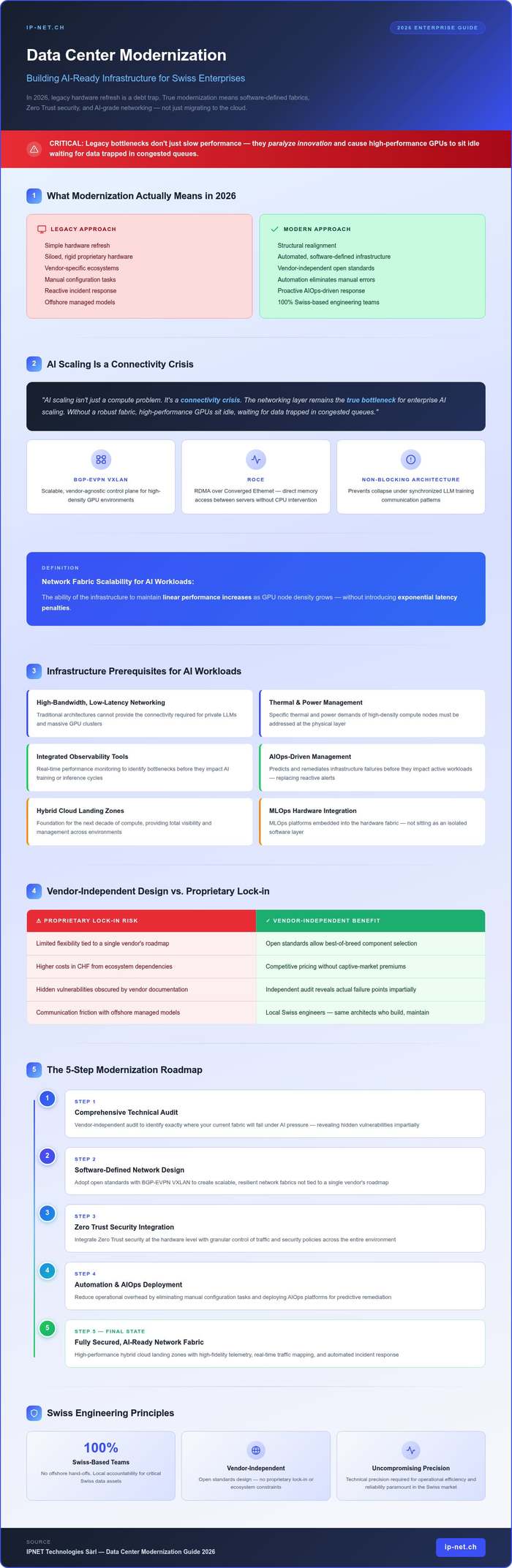
    In 2026, data center modernization is no longer synonymous with a simple migration to the public cloud. It represents a fundamental structural realignment. This transition moves organizations away from siloed, rigid hardware toward automated, software-defined infrastructure that functions as a single, cohesive unit. Comprehensive data center modernization services now focus on building the foundation for the next decade of compute: hybrid cloud landing zones and AIOps-driven management systems that provide total visibility.

    For Swiss enterprises, this evolution carries a specific requirement for local accountability. The shift toward complex, high-performance environments has made offshore managed models increasingly risky. Local engineering teams provide the direct responsibility and technical precision required to manage critical Swiss data assets. This avoids the communication friction and security concerns associated with international hand-offs, ensuring that the architects of the system are the same experts who maintain it.

    The Shift from Legacy to Software-Defined

    Breaking the cycle of proprietary hardware lock-in is the first step toward true agility. By adopting open standards and implementing BGP-EVPN VXLAN, organizations create scalable, resilient network fabrics that aren’t tied to a single vendor’s roadmap. This software-defined approach allows for the granular control of traffic and security policies across the entire environment. Automation plays a central role here. It reduces operational overhead by eliminating manual configuration tasks, which significantly lowers the risk of human error during complex migrations and daily operations.

    Infrastructure Prerequisites for AI Workloads

    The 2026 landscape is dominated by the need to support private Large Language Models (LLMs) and massive GPU clusters. These workloads demand high-bandwidth, low-latency networking that traditional architectures simply cannot provide. Modern data center modernization services must address the specific thermal and power demands of these high-density compute nodes. Beyond physical power, the logical layer requires integrated observability tools. Real-time performance monitoring ensures that bottlenecks are identified before they impact the training or inference cycles of enterprise AI platforms. This level of technical depth ensures the data center isn’t just modernized, it’s structurally prepared for the AI era.

    Architecting for AI: The Network Fabric Core

    AI scaling isn’t just a compute problem. It’s a connectivity crisis. While many focus on power and cooling, the networking layer remains the true bottleneck for enterprise AI scaling. Without a robust fabric, high-performance GPUs sit idle, waiting for data that’s trapped in congested queues. Effective data center modernization services prioritize the elimination of these tail latencies to ensure maximum return on hardware investment. In the Swiss market, where operational efficiency and reliability are paramount, this technical precision is the difference between a functional platform and an expensive failure.

    Eliminating Bottlenecks in GPU Clusters

    Designing for AI requires a shift to non-blocking architectures. Traditional oversubscribed networks collapse under the synchronized communication patterns of distributed Large Language Model (LLM) training. Implementing RDMA over Converged Ethernet (RoCE) is essential. It allows for direct memory access between servers without CPU intervention, slashing latency and reducing overhead. We utilize BGP-EVPN VXLAN to provide the scalable control plane required for these high-density environments. This standard ensures that your fabric remains vendor-agnostic and resilient. Network fabric scalability for AI workloads is the ability of the infrastructure to maintain linear performance increases as GPU node density grows without introducing exponential latency penalties.

    Observability and AIOps Integration

    Proactive observability replaces the reactive cycle. In a modern data center, you can’t wait for a performance degradation to trigger an alert. Utilizing AIOps platforms allows engineering teams to predict and remediate infrastructure failures before they impact active workloads. High-fidelity network telemetry provides the granular visibility needed to map traffic patterns across the fabric in real time. This level of insight allows for automated incident response that maintains the structural integrity of the system. This ensures MLOps platforms are deeply embedded into the hardware fabric rather than sitting as an isolated software layer. If you’re planning a transition, a vendor-independent technical audit identifies exactly where your current fabric will fail under AI pressure.

    Vendor-Independent Design vs. Proprietary Lock-in

    Relying on a single vendor for critical enterprise infrastructure creates a strategic vulnerability that many organizations don’t fully appreciate until a refresh cycle begins. Proprietary ecosystems often masquerade as “unified solutions,” but they frequently result in technical debt and inflated renewal costs in CHF. Professional data center modernization services must prioritize architectural independence to ensure long-term viability. When you’re tied to a single vendor’s lifecycle, their roadmap becomes your limitation, often forcing upgrades that don’t align with your specific business requirements.

    A vendor-independent technical audit is the first step toward reclaiming control of your stack. These assessments reveal where proprietary protocols have created “black boxes” in your network. By identifying these bottlenecks, Swiss enterprises can transition to best-of-breed technologies that offer superior performance for specific workloads, such as AI clusters or high-density campus networking. This Swiss-engineered approach demands technology selection based on empirical performance data rather than marketing alliances. It ensures that the hybrid cloud landing zones you build today remain compatible with the innovations of tomorrow.

    The Freedom of Open Infrastructure Standards

    Leveraging open-source protocols like BGP and VXLAN ensures the underlying fabric remains flexible. It’s about breaking the link between the software control plane and the hardware chassis. This separation allows for more competitive vendor selection during the refresh cycle, significantly reducing the Total Cost of Ownership (TCO). You aren’t just buying hardware; you’re investing in an architecture. A consistent security posture is maintained because policies are defined at the structural level, not dictated by a specific manufacturer’s feature set. This independence allows for the seamless integration of multi-vendor environments that function as a single, high-performance unit.

    Zero Trust Architecture at the Core

    Security is no longer a perimeter add-on. In a modernized environment, Zero Trust is integrated directly into the data center fabric. This allows for granular micro-segmentation that contains the lateral movement of threats within the internal network. By implementing SASE (Secure Access Service Edge), organizations extend this secure environment to remote resources. This ensures access to sensitive internal applications is strictly controlled and verified, regardless of where the user is located. This structural security model protects your data assets at the hardware level, providing a level of resilience that software-only solutions can’t match.

    Executing the Modernization Roadmap: A 5-Step Framework

    Successful infrastructure transformation requires more than just technical skill. It demands a methodical approach that balances current operational stability with future-ready scalability. Organizations often fail when they treat migration as a simple lift and shift exercise. High-performance data center modernization services provide the structured framework necessary to navigate these complexities without compromising mission-critical uptime. This roadmap ensures that every layer of the stack, from the physical cabling to the AIOps management layer, is optimized for the AI era.

    • Step 1: Technical Audit and AI-Readiness Assessment. We baseline your current environment to identify technical debt and performance bottlenecks.
    • Step 2: Strategic Design of the Fabric. We architect a software-defined network and security layer based on open standards.
    • Step 3: Staged Migration Planning. This phase focuses on risk mitigation to ensure zero downtime for legacy applications.
    • Step 4: Automation and Observability Deployment. We integrate the tools required for real-time telemetry and automated lifecycle management.
    • Step 5: Transition to Managed AIOps. We move the environment into a state of 24/7 proactive operations and continuous optimization.

    The Critical Role of the IT Audit

    A granular technical audit is the foundation of structural integrity. We don’t just look at hardware specs; we map data flows to optimize hybrid cloud connectivity. This process identifies legacy bottlenecks that would otherwise cripple AI performance. A vendor-independent infrastructure audit is a comprehensive technical assessment of the existing network, compute, and security layers to identify performance gaps and proprietary dependencies that hinder scalability. This clarity allows for a design that addresses your specific requirements rather than following a vendor’s generic template.

    Managing Complex Migrations

    Bridging the gap between legacy systems and modern fabrics is a delicate engineering challenge. We use network virtualization to maintain connectivity during the transition, ensuring that data integrity is never compromised. This staged approach allows for the systematic movement of workloads without the risk of extended outages. Our 100% Swiss-based engineering teams provide direct, on-site accountability throughout the migration lifecycle. This local expertise is essential for resolving the unforeseen technical hurdles that often arise in complex enterprise environments. If you’re ready to begin your transition, you can schedule a technical consultation with our architects today.

    IPNET: Uncompromising Swiss Engineering for Data Centers

    IPNET Technologies Sàrl stands as a specialized systems integrator dedicated to the structural integrity of national enterprise infrastructure. Founded in 2006, our firm has spent two decades refining the methodologies required to navigate complex digital shifts with precision. While many data center modernization services rely on fragmented support models or offshore labor, we maintain a strictly national engineering presence. This ensures that the architects who design your high-performance fabric are the same experts who manage its daily operational lifecycle. We provide a direct bridge between legacy stability and the high-density compute demands of the 2026 landscape.

    Direct Swiss Accountability

    Direct Swiss accountability is the cornerstone of our operational philosophy. Swiss enterprises operate within a unique regulatory and data sovereignty environment that demands a partner with deep local roots. We eliminate the communication friction and security risks inherent in global support tiers. There are no offshore hand-offs; every engineer on our team is based within the country. This model builds long-term partnerships rooted in technical excellence and reliable incident response. It’s a level of commitment that global integrators simply cannot replicate for the Swiss market, where precision and reliability are mandatory.

    Next Steps for Your Infrastructure

    Positioning your infrastructure for the next decade of AI-driven growth requires a holistic view of the enterprise stack. We help you integrate SD-WAN deployment and enterprise campus networking into a unified architectural strategy. This ensures that the low-latency gains achieved in the data center are maintained across the entire network edge. To initiate an AI-readiness assessment, we perform a granular technical audit of your current environment to identify the specific path toward modernization. We then transition your systems to managed AIOps, providing proactive, 24/7 monitoring that identifies failures before they impact your MLOps platforms.

    Modernizing your infrastructure is a strategic investment in your organization’s future agility. We provide the expertise needed to transform legacy silos into automated, vendor-independent environments that function with precision. Our focus remains on functional outcomes and technical excellence rather than making an easy sale. If you’re ready to secure your operational future and ensure your compute environment is an engine for innovation, we are prepared to lead the way. You can consult with our Swiss engineering team on your modernization strategy today to begin building an environment that scales with your ambition.

    Architecting for Structural Integrity in the AI Era

    The transition to high-performance infrastructure requires a fundamental shift in how we view the networking fabric. It’s about moving beyond legacy silos. We build resilient, automated environments that treat AI workloads as the standard, not the exception. By prioritizing vendor-independent design and software-defined architectures, your organization secures the agility needed to adapt as technologies evolve. Utilizing professional data center modernization services ensures that this transition is grounded in empirical performance data rather than proprietary marketing promises. IPNET brings over 20 years of infrastructure expertise to every project. We provide a 100% Swiss-based engineering team to ensure direct accountability and technical precision. Our role is to act as a trusted advisor, helping you navigate complex migrations while maintaining structural integrity. We don’t just deploy hardware; we architect future-ready environments. Architect your future-ready data center with IPNET Swiss engineering and build a foundation that scales with your ambition. Your infrastructure is the engine of your innovation, and it’s time to ensure it’s ready for the demands of 2026.

    Frequently Asked Questions

    What are the primary benefits of data center modernization services?

    Modernization provides the structural agility required to deploy software-defined infrastructure and automated network fabrics. These data center modernization services eliminate legacy bottlenecks that restrict scaling. Organizations benefit from reduced operational overhead and the ability to integrate hybrid cloud landing zones seamlessly. By transitioning from siloed hardware to a unified, programmable environment, Swiss enterprises ensure their infrastructure remains a competitive asset rather than a source of technical debt.

    How does modernizing a data center support AI and machine learning workloads?

    Modernization addresses the specific high-density compute and low-latency networking requirements of GPU clusters. It involves implementing non-blocking architectures and RDMA over Converged Ethernet (RoCE) to ensure data moves at the speed of modern processors. This structural realignment prevents the networking layer from becoming a bottleneck during Large Language Model (LLM) training. It creates an environment where MLOps platforms can function with maximum efficiency and predictable performance.

    What is the role of BGP-EVPN VXLAN in modern data center architecture?

    BGP-EVPN VXLAN serves as the standardized control plane for scalable, resilient network fabrics. It allows for the creation of virtualized overlays on top of a physical underlay, providing granular control over traffic and security policies. This architecture ensures vendor independence by utilizing open standards rather than proprietary protocols. It’s the foundation for building automated environments that can scale across multiple data center locations while maintaining a consistent operational model.

    Why is vendor independence important for enterprise infrastructure?

    Vendor independence prevents proprietary lock-in and the associated inflation of renewal costs in CHF. It allows organizations to select best-of-breed technology for specific use cases, such as AI infrastructure or campus networking. By relying on open standards, enterprises maintain long-term architectural flexibility and can negotiate more competitive terms during refresh cycles. This approach ensures that your infrastructure roadmap is dictated by your business requirements rather than a single manufacturer’s product lifecycle.

    How much does a data center modernization project typically cost?

    The cost of a modernization project depends on the scale of the environment, the complexity of the migration, and the amount of existing technical debt. Factors such as the transition to high-performance GPU networking or the implementation of Zero Trust security layers also influence the investment. We recommend starting with a vendor-independent technical audit to identify specific requirements. This provides a clear roadmap and allows for accurate resource allocation based on your unique infrastructure goals.

    What are the security implications of data center modernization?

    Modernization integrates security directly into the hardware fabric through Zero Trust architecture and granular micro-segmentation. This model assumes no implicit trust, requiring verification for every connection and containing the lateral movement of threats. By integrating SASE, organizations extend this secure posture to remote access and branch locations. This structural approach protects critical Swiss data assets at the foundation, providing far greater resilience than traditional perimeter-based security solutions.

    How does IPNET ensure zero downtime during a data center migration?

    We utilize network virtualization and a meticulous five-step framework to bridge legacy and modern environments during the transition. This allows for the staged migration of mission-critical applications without disrupting active services. Our 100% Swiss-based engineering teams provide direct, on-site accountability to resolve technical hurdles in real time. By mapping data flows and testing configurations in parallel environments, we ensure data integrity and operational continuity throughout the entire data center modernization services lifecycle.

    What is the difference between reactive monitoring and proactive AIOps?

    Reactive monitoring relies on static thresholds and alerts that trigger after a performance degradation or failure has occurred. In contrast, proactive AIOps utilizes machine learning to analyze real-time telemetry and predict infrastructure issues before they impact workloads. This allows for automated remediation and continuous optimization of the network fabric. Transitioning to managed AIOps ensures 24/7 proactive operations, moving your engineering team from constant firefighting to strategic infrastructure development.

  • Modern Data Center Design: Strategic Guide for 2026

    Modern Data Center Design: Strategic Guide for 2026

    The traditional enterprise facility has reached its physical limit. By 2026, any infrastructure failing to support high-density liquid cooling and automated network fabrics isn’t just outdated; it’s a functional liability. Implementing a modern data center design is no longer optional for organizations running heavy AI workloads that demand more than a standard power envelope can deliver. You’re likely seeing rising energy costs and cooling inefficiencies that directly impact your CHF-denominated operational expenditure. We understand that managing vendor-locked environments while trying to scale is a losing battle.

    This strategic guide provides the technical blueprint you need to transition from legacy setups to scalable, AI-ready architectures built on uncompromising Swiss reliability. You’ll learn how to master high-density compute requirements and vendor-independent BGP-EVPN VXLAN fabrics. We’ll examine specific methods to drive down Power Usage Effectiveness (PUE) through local, Swiss-engineered accountability and rigorous structural integrity. The result is a future-proof environment that prioritizes performance over marketing promises.

    Key Takeaways

    • Identify the core architectural requirements for 2026, shifting from legacy silos to high-density environments optimized for intensive AI workloads.
    • Master the transition to non-blocking fabrics using BGP-EVPN VXLAN, a critical component of modern data center design that ensures seamless GPU-to-GPU connectivity.
    • Leverage the Swiss advantage of local accountability and on-site engineering to maintain uncompromising structural integrity and data sovereignty.
    • Execute a vendor-independent modernization roadmap that prioritizes technical audits and minimizes disruption during complex infrastructure migrations.
    • Integrate proactive managed AIOps into your operational stack to move beyond reactive monitoring toward 24/7 predictive maintenance and stability.

    Table of Contents

    The Shift to AI-Ready Architecture: Defining Modern Data Center Design in 2026

    The enterprise facility of 2026 isn’t a passive repository for hardware. It’s a high-performance engine specifically tuned for the rigors of artificial intelligence and distributed hybrid cloud environments. Traditional architectures relied on siloed designs that prioritized vertical scaling for monolithic applications. These legacy systems fail when confronted with the massive throughput and ultra-low latency requirements of modern AI model training. A successful modern data center design must move beyond basic uptime. It must ensure that the physical infrastructure can sustain the continuous, heavy-duty cycles of GPU clusters without thermal throttling or network congestion.

    While basic data center design fundamentals still apply, the metrics for success have evolved. Power Usage Effectiveness (PUE) remains a vital benchmark for Swiss efficiency standards, yet it’s no longer the sole indicator of health. In 2026, we measure AI-workload efficiency. This metric assesses the facility’s ability to deliver targeted power to high-density compute nodes while maintaining the structural integrity of the cooling loop. It’s the essential foundation for private LLM deployments and MLOps success. Without this specialized architectural baseline, the most advanced software stacks will eventually stall at the physical layer.

    From Traditional Racks to High-Density AI Clusters

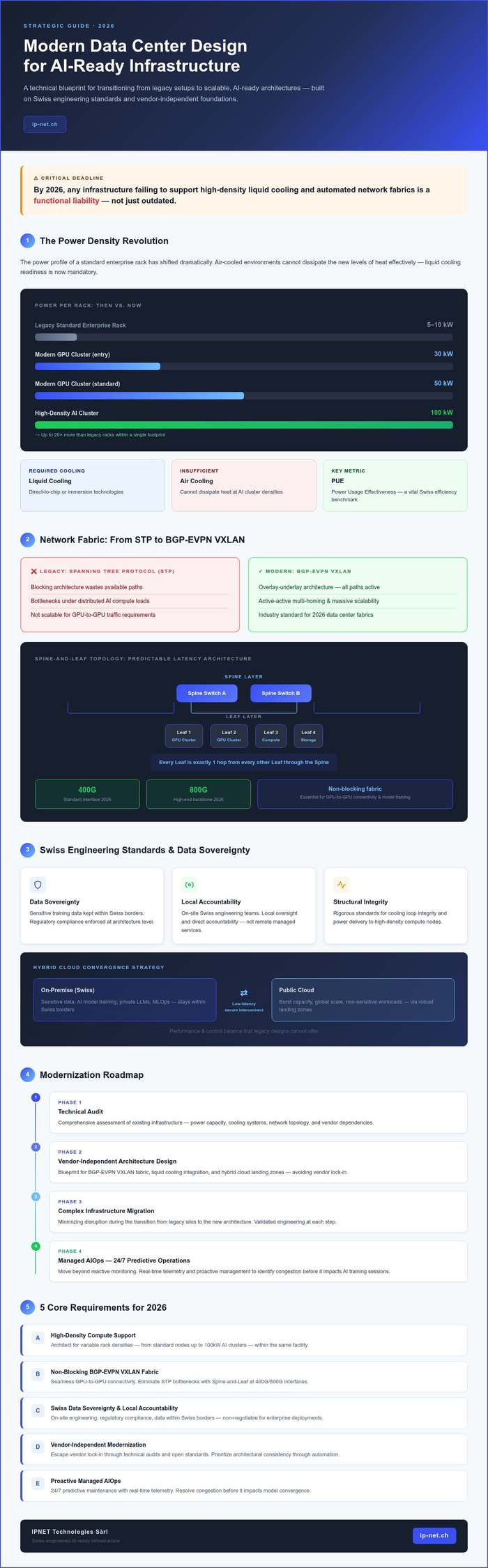
    The power profile of a standard enterprise rack has shifted dramatically. In the past, 5kW to 10kW per rack was the standard. Today’s GPU clusters frequently demand 30kW, 50kW, or even 100kW within a single footprint. Air-cooled environments cannot dissipate this level of heat effectively. Modern facilities must transition toward liquid cooling readiness, specifically direct-to-chip or immersion technologies. Designers must architect for variable rack densities. This allows high-performance AI clusters to coexist with standard compute nodes without compromising the overall thermal management strategy.

    The Convergence of On-Premise and Hybrid Cloud

    Strategic infrastructure requires a seamless bridge between local hardware and public resources through robust landing zones. For Swiss enterprises, this convergence is heavily influenced by data sovereignty and regulatory compliance. Keeping sensitive training data within Swiss borders while utilizing cloud-based burst capacity requires a sophisticated interconnect strategy. We focus on architecting low-latency paths that ensure data moves securely between hybrid environments. This approach maintains local accountability while providing the scalability needed for global operations. It’s a balance of performance and control that legacy designs simply can’t offer.

    Engineering the Network Fabric: BGP-EVPN VXLAN and AI GPU Connectivity

    Spanning Tree Protocol (STP) has no place in a modern data center design optimized for AI. It’s an artifact of a bygone era. Modern workloads require the full utilization of all available paths, which is why BGP-EVPN VXLAN provides an overlay-underlay architecture that enables active-active multi-homing and massive scalability. This shift eliminates the bottlenecks inherent in legacy blocking architectures. It ensures that traffic flows across the fabric with the efficiency required for distributed compute clusters.

    Human error remains a primary cause of network instability. Automation isn’t just about deployment speed; it’s about architectural consistency. By implementing automated network fabrics, enterprises ensure every switch configuration adheres to a validated engineering blueprint. This level of control is supported by fabric-level observability. Real-time telemetry provides the granular data needed to monitor mission-critical AI training sessions. It allows engineers to identify and resolve congestion before it impacts model convergence.

    Modern Switching Architecture for Scalability

    The Spine-and-Leaf topology is the structural requirement for predictable latency. Every Leaf switch is exactly one hop away from every other Leaf switch through the Spine. This creates a non-blocking environment essential for the 400G and 800G interfaces now standard in 2026 backbones. BGP-EVPN VXLAN stands as the industry standard for scalable data center fabrics in 2026, offering the control plane stability required for multi-tenant environments. Adhering to data center energy and infrastructure standards ensures these high-speed interfaces operate within sustainable power and thermal limits.

    AI Cluster Networking: RoCE vs. InfiniBand

    GPU-to-GPU communication demands Remote Direct Memory Access (RDMA) to bypass CPU overhead. While InfiniBand remains a specialized choice for pure HPC, RDMA over Converged Ethernet (RoCE) has become the pragmatic standard for enterprise AI. It allows organizations to leverage existing Ethernet expertise while achieving the lossless performance required for MLOps. Minimizing jitter is non-negotiable when training large language models. Strategic vendor independence allows you to select switching silicon based on performance metrics rather than brand loyalty. If you’re currently assessing your fabric readiness, consulting with a specialist in modern data center design ensures your infrastructure is built for the next decade of compute.

    Swiss Engineering Standards: Resilience, Sovereignty, and Local Accountability

    Swiss engineering represents a commitment to structural integrity that generic global deployment models rarely match. It’s the difference between a standard facility and a precision-built environment designed for decades of stable operation. In a modern data center design, this regional precision manifests as direct accountability. We don’t rely on offshore hand-offs or abstracted support tiers. Instead, the engineers who architect the system are the same professionals responsible for its long-term performance. This creates a feedback loop of technical excellence that ensures your infrastructure remains resilient against both physical and digital threats.

    Generic deployment models often prioritize speed and cost over the specific regulatory nuances of the Swiss market. By contrast, a localized approach integrates Swiss data protection requirements into the very foundation of the architecture. This isn’t just about where the servers sit; it’s about who has access to the management plane and how maintenance is conducted. Local oversight prevents the security gaps that frequently emerge when infrastructure management is outsourced to distant timezones with different legal frameworks.

    Tier Standards and EN 50600 Compliance

    Selecting the right resilience level is a strategic decision. While Uptime Institute Tier III offers concurrent maintainability with 99.982% uptime, Tier IV provides full fault tolerance for mission-critical environments. For many Swiss enterprises, the sweet spot lies in a hybrid approach: designing for 2N redundancy in power systems while maintaining N+1 efficiency for cooling. We also adhere to the EN 50600 series. This transnational standard provides a holistic framework for planning, covering everything from building construction to telecommunications cabling and security systems. It ensures every component of the facility works in harmony to support high-density workloads.

    Data Sovereignty as a Design Requirement

    Sovereignty is a core design constraint, not an afterthought. Keeping critical infrastructure under Swiss jurisdiction is essential for regulatory compliance and national security. Offshore management introduces risks that are often overlooked, such as jurisdictional overreach or communication delays during a crisis. Our model prioritizes 24/7 Swiss-based managed operations to eliminate these variables. You get immediate response times without language barriers or timezone conflicts. This level of local accountability ensures that your data remains secure and your operations stay within the protective boundaries of Swiss law.

    The Modernization Roadmap: Migration and Strategic Lifecycle Management

    Modernization isn’t a one-time project. It’s a strategic lifecycle that demands a 10-year vision rather than a 12-month patch. Legacy infrastructure often creates a cascade of technical debt that limits your ability to scale AI operations. To break this cycle, a modern data center design must begin with a vendor-independent technical audit. This assessment identifies where your current power delivery, thermal management, and network fabrics fail to meet the requirements of 2026. By establishing a clear AI-readiness roadmap, you can minimize operational disruption during the transition from legacy silos to automated fabrics.

    Step-by-Step Modernization Strategy

    A structured approach ensures that complex migrations don’t compromise current stability. We follow a methodical three-phase framework:

    • Phase 1: Site Surveys and Audits. We conduct comprehensive technical reviews of physical and logical infrastructure to establish a performance baseline.
    • Phase 2: Fabric and Landing Zone Design. This phase involves architecting the automated network fabric and hybrid cloud landing zones discussed in previous sections.
    • Phase 3: Swiss-Engineered Execution. Migration occurs in controlled stages under direct Swiss engineering oversight. We don’t use offshore hand-offs, ensuring that the team who designed the system is the team that builds it.

    Zero Trust Architecture in the Data Center

    Security must be integrated into the physical and logical design phase, not bolted on later. Zero Trust is the mandatory standard for 2026. This begins with implementing micro-segmentation to contain the lateral movement of threats across your high-performance compute nodes. Securing the management plane is a prerequisite for any modern infrastructure. Without a hardened control plane, your automated fabric remains vulnerable to sophisticated attacks. We integrate SASE and firewall management directly into the core modern data center design, creating a unified security posture that protects both local and hybrid resources. If you’re ready to evaluate your current infrastructure, we can provide a comprehensive technical audit to guide your next decade of growth.

    Operational Excellence: Managed AIOps and the Future of Data Center Support

    A modern data center design is not a static facility project. It is a lived operational cycle that requires continuous refinement to maintain peak performance. Traditional monitoring is reactive; it tells you when a system has already failed. By contrast, the future of infrastructure support lies in proactive Managed AIOps. This approach leverages deep observability to identify thermal anomalies or network congestion before they escalate into outages. It ensures that the high-density fabrics and GPU clusters architected in previous phases remain stable under the most demanding AI training cycles.

    The final piece of the architectural puzzle is 24/7 Swiss-based managed operations. Local accountability is the only way to guarantee the rapid response times required for mission-critical systems. We eliminate the risks associated with offshore hand-offs by maintaining a dedicated team of Swiss engineers who understand the specific nuances of your environment. This model provides the stability needed to protect your CHF-denominated infrastructure investments while ensuring compliance with national data sovereignty standards. It bridges the gap between initial technical execution and long-term functional success.

    Managed AIOps: Incident Response at the Speed of AI

    Predictive maintenance is a core component of modern operational excellence. We use machine learning algorithms to analyze telemetry from power distribution units and cooling loops to predict hardware failures before they occur. This is paired with automated patch management and firmware updates to maintain a hardened security posture across the entire fabric. Managed AIOps reduces Mean Time to Repair (MTTR) by correlating disparate telemetry data to isolate root causes instantly in complex hybrid environments. This level of automation allows your internal teams to focus on MLOps and innovation rather than routine maintenance.

    Vendor Independence: Building for Long-Term Freedom

    Proprietary hardware ecosystems often hide significant long-term costs. Vendor lock-in limits your ability to adopt newer, more efficient technologies as they emerge in 2026 and beyond. Our independent advisory ensures your stack is built on best-of-breed technology selected for performance rather than brand loyalty. This approach maintains the structural integrity of your modern data center design while providing the flexibility to pivot as your compute requirements evolve. Contact our Swiss engineering team for a vendor-independent audit of your current data center strategy to ensure your infrastructure is truly future-ready.

    Architecting for the AI-Driven Decade

    The transition to a modern data center design is a strategic pivot that determines your organization’s ability to compete in a high-density, AI-driven market. Legacy facilities don’t possess the thermal management or network throughput required for 2026 workloads. By integrating the automated fabrics and Swiss engineering standards discussed throughout this guide, you secure a foundation that is both resilient and sovereign. Accountability shouldn’t be outsourced to distant timezones; it belongs with local experts who understand the structural integrity of your systems.

    IPNET Technologies Sàrl has been Swiss-owned and operated since 2006, providing the deep expertise needed to deploy high-performance AI GPU clusters. Our 24/7 Swiss-based managed operations ensure your infrastructure remains optimized long after the initial migration. Don’t let technical debt bottleneck your innovation. Consult with our Swiss-based engineering team for an AI-ready data center design and build a facility that matches your ambitions. Your future-ready environment is within reach.

    Frequently Asked Questions

    What are the main components of modern data center design in 2026?

    The core components of modern data center design in 2026 include high-density GPU clusters, automated network fabrics using BGP-EVPN VXLAN, and liquid cooling readiness. These facilities prioritize structural integrity and variable rack densities to support power-intensive AI workloads. Secure hybrid cloud landing zones and integrated Zero Trust security frameworks are also essential. These elements ensure the infrastructure is scalable, vendor-independent, and capable of delivering the throughput required for private LLM deployments.

    How does AI impact data center cooling and power requirements?

    AI workloads significantly increase power density, often requiring 30kW to 100kW per rack compared to the traditional 5kW standard. This shift renders traditional air cooling insufficient, necessitating a transition to advanced liquid cooling technologies like direct-to-chip or immersion systems. Modern designs must architect for these thermal demands while maintaining high power usage effectiveness (PUE). Effective management ensures that high-performance compute nodes operate without thermal throttling or structural degradation.

    Why is Swiss-based engineering important for data center design?

    Swiss-based engineering provides direct accountability and ensures that critical infrastructure remains under Swiss jurisdiction for regulatory compliance. This “no offshore” approach eliminates the security gaps and communication delays often found in global deployment models. Local teams offer immediate response times and a deep understanding of national data protection laws. By maintaining oversight within Switzerland, enterprises ensure their data sovereignty and long-term operational stability are never compromised by distant jurisdictional shifts.

    What is the difference between RoCE and InfiniBand for AI networking?

    RoCE (RDMA over Converged Ethernet) allows enterprises to leverage existing Ethernet expertise while achieving the low-latency, lossless performance required for AI clusters. InfiniBand is a specialized interconnect traditionally used in high-performance computing (HPC) environments. While InfiniBand offers high throughput, RoCE has become a pragmatic choice for modern data center design due to its versatility and vendor independence. Both technologies aim to minimize CPU overhead through direct memory access between GPUs.

    How can I modernize my legacy data center without significant downtime?

    Modernization is achieved through a phased strategy that begins with a vendor-independent technical audit to identify performance bottlenecks. We implement hybrid cloud landing zones to create a bridge between legacy hardware and new automated fabrics. This allows for controlled, phased migrations under direct Swiss engineering oversight. By architecting redundant paths and utilizing non-blocking topologies, enterprises can transition to AI-ready infrastructure while maintaining the continuous stability of their current production operations.

    What is EN 50600 and why is it relevant for Swiss enterprises?

    EN 50600 is the comprehensive transnational standard for data center facilities and infrastructures. It provides a holistic framework for planning building construction, power distribution, environmental control, and security systems. For Swiss enterprises, adhering to EN 50600 ensures that the facility meets rigorous European requirements for resilience and efficiency. It serves as a blueprint for designing N+1 or 2N redundancy, ensuring that every component of the infrastructure supports long-term operational excellence.

    How do managed AIOps services improve data center reliability?

    Managed AIOps services transition infrastructure support from reactive monitoring to proactive, predictive operations. By using machine learning to analyze real-time telemetry, these systems identify hardware failures and thermal anomalies before they impact uptime. This approach significantly reduces Mean Time to Repair (MTTR) in complex hybrid environments. Combined with 24/7 Swiss-based support, AIOps ensures that automated fabrics and high-density compute clusters remain secure and optimized through continuous, data-driven oversight.

    What is a hybrid cloud landing zone in the context of data center design?

    A hybrid cloud landing zone is a secure, architected environment that bridges local hardware with public cloud resources. It serves as the foundation for data sovereignty, ensuring that sensitive AI training data remains within Swiss borders while utilizing cloud scalability for burst capacity. This design prioritizes low-latency interconnectivity and consistent security policies across all environments. It allows enterprises to maintain local accountability while benefiting from the flexibility of a modern, multi-cloud infrastructure stack.