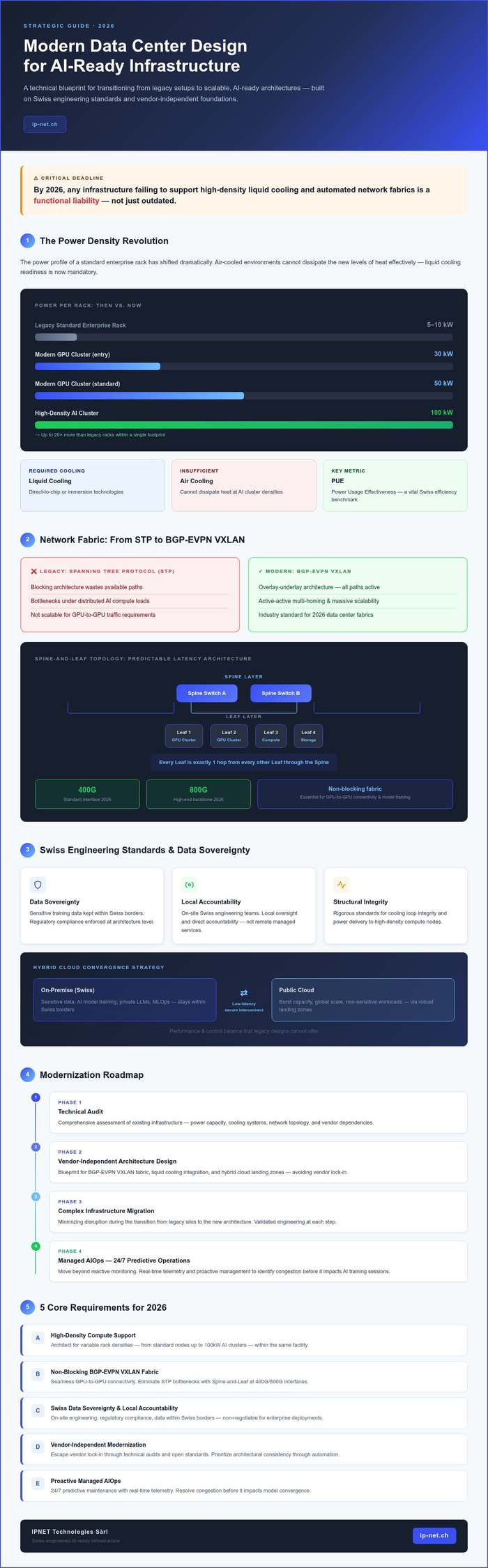
The traditional enterprise facility has reached its physical limit. By 2026, any infrastructure failing to support high-density liquid cooling and automated network fabrics isn’t just outdated; it’s a functional liability. Implementing a modern data center design is no longer optional for organizations running heavy AI workloads that demand more than a standard power envelope can deliver. You’re likely seeing rising energy costs and cooling inefficiencies that directly impact your CHF-denominated operational expenditure. We understand that managing vendor-locked environments while trying to scale is a losing battle.
This strategic guide provides the technical blueprint you need to transition from legacy setups to scalable, AI-ready architectures built on uncompromising Swiss reliability. You’ll learn how to master high-density compute requirements and vendor-independent BGP-EVPN VXLAN fabrics. We’ll examine specific methods to drive down Power Usage Effectiveness (PUE) through local, Swiss-engineered accountability and rigorous structural integrity. The result is a future-proof environment that prioritizes performance over marketing promises.
Key Takeaways
- Identify the core architectural requirements for 2026, shifting from legacy silos to high-density environments optimized for intensive AI workloads.
- Master the transition to non-blocking fabrics using BGP-EVPN VXLAN, a critical component of modern data center design that ensures seamless GPU-to-GPU connectivity.
- Leverage the Swiss advantage of local accountability and on-site engineering to maintain uncompromising structural integrity and data sovereignty.
- Execute a vendor-independent modernization roadmap that prioritizes technical audits and minimizes disruption during complex infrastructure migrations.
- Integrate proactive managed AIOps into your operational stack to move beyond reactive monitoring toward 24/7 predictive maintenance and stability.
Table of Contents
- The Shift to AI-Ready Architecture: Defining Modern Data Center Design in 2026
- Engineering the Network Fabric: BGP-EVPN VXLAN and AI GPU Connectivity
- Swiss Engineering Standards: Resilience, Sovereignty, and Local Accountability
- The Modernization Roadmap: Migration and Strategic Lifecycle Management
- Operational Excellence: Managed AIOps and the Future of Data Center Support
The Shift to AI-Ready Architecture: Defining Modern Data Center Design in 2026
The enterprise facility of 2026 isn’t a passive repository for hardware. It’s a high-performance engine specifically tuned for the rigors of artificial intelligence and distributed hybrid cloud environments. Traditional architectures relied on siloed designs that prioritized vertical scaling for monolithic applications. These legacy systems fail when confronted with the massive throughput and ultra-low latency requirements of modern AI model training. A successful modern data center design must move beyond basic uptime. It must ensure that the physical infrastructure can sustain the continuous, heavy-duty cycles of GPU clusters without thermal throttling or network congestion.
While basic data center design fundamentals still apply, the metrics for success have evolved. Power Usage Effectiveness (PUE) remains a vital benchmark for Swiss efficiency standards, yet it’s no longer the sole indicator of health. In 2026, we measure AI-workload efficiency. This metric assesses the facility’s ability to deliver targeted power to high-density compute nodes while maintaining the structural integrity of the cooling loop. It’s the essential foundation for private LLM deployments and MLOps success. Without this specialized architectural baseline, the most advanced software stacks will eventually stall at the physical layer.
From Traditional Racks to High-Density AI Clusters
The power profile of a standard enterprise rack has shifted dramatically. In the past, 5kW to 10kW per rack was the standard. Today’s GPU clusters frequently demand 30kW, 50kW, or even 100kW within a single footprint. Air-cooled environments cannot dissipate this level of heat effectively. Modern facilities must transition toward liquid cooling readiness, specifically direct-to-chip or immersion technologies. Designers must architect for variable rack densities. This allows high-performance AI clusters to coexist with standard compute nodes without compromising the overall thermal management strategy.
The Convergence of On-Premise and Hybrid Cloud
Strategic infrastructure requires a seamless bridge between local hardware and public resources through robust landing zones. For Swiss enterprises, this convergence is heavily influenced by data sovereignty and regulatory compliance. Keeping sensitive training data within Swiss borders while utilizing cloud-based burst capacity requires a sophisticated interconnect strategy. We focus on architecting low-latency paths that ensure data moves securely between hybrid environments. This approach maintains local accountability while providing the scalability needed for global operations. It’s a balance of performance and control that legacy designs simply can’t offer.
Engineering the Network Fabric: BGP-EVPN VXLAN and AI GPU Connectivity
Spanning Tree Protocol (STP) has no place in a modern data center design optimized for AI. It’s an artifact of a bygone era. Modern workloads require the full utilization of all available paths, which is why BGP-EVPN VXLAN provides an overlay-underlay architecture that enables active-active multi-homing and massive scalability. This shift eliminates the bottlenecks inherent in legacy blocking architectures. It ensures that traffic flows across the fabric with the efficiency required for distributed compute clusters.
Human error remains a primary cause of network instability. Automation isn’t just about deployment speed; it’s about architectural consistency. By implementing automated network fabrics, enterprises ensure every switch configuration adheres to a validated engineering blueprint. This level of control is supported by fabric-level observability. Real-time telemetry provides the granular data needed to monitor mission-critical AI training sessions. It allows engineers to identify and resolve congestion before it impacts model convergence.
Modern Switching Architecture for Scalability
The Spine-and-Leaf topology is the structural requirement for predictable latency. Every Leaf switch is exactly one hop away from every other Leaf switch through the Spine. This creates a non-blocking environment essential for the 400G and 800G interfaces now standard in 2026 backbones. BGP-EVPN VXLAN stands as the industry standard for scalable data center fabrics in 2026, offering the control plane stability required for multi-tenant environments. Adhering to data center energy and infrastructure standards ensures these high-speed interfaces operate within sustainable power and thermal limits.
AI Cluster Networking: RoCE vs. InfiniBand
GPU-to-GPU communication demands Remote Direct Memory Access (RDMA) to bypass CPU overhead. While InfiniBand remains a specialized choice for pure HPC, RDMA over Converged Ethernet (RoCE) has become the pragmatic standard for enterprise AI. It allows organizations to leverage existing Ethernet expertise while achieving the lossless performance required for MLOps. Minimizing jitter is non-negotiable when training large language models. Strategic vendor independence allows you to select switching silicon based on performance metrics rather than brand loyalty. If you’re currently assessing your fabric readiness, consulting with a specialist in modern data center design ensures your infrastructure is built for the next decade of compute.
Swiss Engineering Standards: Resilience, Sovereignty, and Local Accountability
Swiss engineering represents a commitment to structural integrity that generic global deployment models rarely match. It’s the difference between a standard facility and a precision-built environment designed for decades of stable operation. In a modern data center design, this regional precision manifests as direct accountability. We don’t rely on offshore hand-offs or abstracted support tiers. Instead, the engineers who architect the system are the same professionals responsible for its long-term performance. This creates a feedback loop of technical excellence that ensures your infrastructure remains resilient against both physical and digital threats.
Generic deployment models often prioritize speed and cost over the specific regulatory nuances of the Swiss market. By contrast, a localized approach integrates Swiss data protection requirements into the very foundation of the architecture. This isn’t just about where the servers sit; it’s about who has access to the management plane and how maintenance is conducted. Local oversight prevents the security gaps that frequently emerge when infrastructure management is outsourced to distant timezones with different legal frameworks.
Tier Standards and EN 50600 Compliance
Selecting the right resilience level is a strategic decision. While Uptime Institute Tier III offers concurrent maintainability with 99.982% uptime, Tier IV provides full fault tolerance for mission-critical environments. For many Swiss enterprises, the sweet spot lies in a hybrid approach: designing for 2N redundancy in power systems while maintaining N+1 efficiency for cooling. We also adhere to the EN 50600 series. This transnational standard provides a holistic framework for planning, covering everything from building construction to telecommunications cabling and security systems. It ensures every component of the facility works in harmony to support high-density workloads.
Data Sovereignty as a Design Requirement
Sovereignty is a core design constraint, not an afterthought. Keeping critical infrastructure under Swiss jurisdiction is essential for regulatory compliance and national security. Offshore management introduces risks that are often overlooked, such as jurisdictional overreach or communication delays during a crisis. Our model prioritizes 24/7 Swiss-based managed operations to eliminate these variables. You get immediate response times without language barriers or timezone conflicts. This level of local accountability ensures that your data remains secure and your operations stay within the protective boundaries of Swiss law.
The Modernization Roadmap: Migration and Strategic Lifecycle Management
Modernization isn’t a one-time project. It’s a strategic lifecycle that demands a 10-year vision rather than a 12-month patch. Legacy infrastructure often creates a cascade of technical debt that limits your ability to scale AI operations. To break this cycle, a modern data center design must begin with a vendor-independent technical audit. This assessment identifies where your current power delivery, thermal management, and network fabrics fail to meet the requirements of 2026. By establishing a clear AI-readiness roadmap, you can minimize operational disruption during the transition from legacy silos to automated fabrics.
Step-by-Step Modernization Strategy
A structured approach ensures that complex migrations don’t compromise current stability. We follow a methodical three-phase framework:
- Phase 1: Site Surveys and Audits. We conduct comprehensive technical reviews of physical and logical infrastructure to establish a performance baseline.
- Phase 2: Fabric and Landing Zone Design. This phase involves architecting the automated network fabric and hybrid cloud landing zones discussed in previous sections.
- Phase 3: Swiss-Engineered Execution. Migration occurs in controlled stages under direct Swiss engineering oversight. We don’t use offshore hand-offs, ensuring that the team who designed the system is the team that builds it.
Zero Trust Architecture in the Data Center
Security must be integrated into the physical and logical design phase, not bolted on later. Zero Trust is the mandatory standard for 2026. This begins with implementing micro-segmentation to contain the lateral movement of threats across your high-performance compute nodes. Securing the management plane is a prerequisite for any modern infrastructure. Without a hardened control plane, your automated fabric remains vulnerable to sophisticated attacks. We integrate SASE and firewall management directly into the core modern data center design, creating a unified security posture that protects both local and hybrid resources. If you’re ready to evaluate your current infrastructure, we can provide a comprehensive technical audit to guide your next decade of growth.
Operational Excellence: Managed AIOps and the Future of Data Center Support
A modern data center design is not a static facility project. It is a lived operational cycle that requires continuous refinement to maintain peak performance. Traditional monitoring is reactive; it tells you when a system has already failed. By contrast, the future of infrastructure support lies in proactive Managed AIOps. This approach leverages deep observability to identify thermal anomalies or network congestion before they escalate into outages. It ensures that the high-density fabrics and GPU clusters architected in previous phases remain stable under the most demanding AI training cycles.
The final piece of the architectural puzzle is 24/7 Swiss-based managed operations. Local accountability is the only way to guarantee the rapid response times required for mission-critical systems. We eliminate the risks associated with offshore hand-offs by maintaining a dedicated team of Swiss engineers who understand the specific nuances of your environment. This model provides the stability needed to protect your CHF-denominated infrastructure investments while ensuring compliance with national data sovereignty standards. It bridges the gap between initial technical execution and long-term functional success.
Managed AIOps: Incident Response at the Speed of AI
Predictive maintenance is a core component of modern operational excellence. We use machine learning algorithms to analyze telemetry from power distribution units and cooling loops to predict hardware failures before they occur. This is paired with automated patch management and firmware updates to maintain a hardened security posture across the entire fabric. Managed AIOps reduces Mean Time to Repair (MTTR) by correlating disparate telemetry data to isolate root causes instantly in complex hybrid environments. This level of automation allows your internal teams to focus on MLOps and innovation rather than routine maintenance.
Vendor Independence: Building for Long-Term Freedom
Proprietary hardware ecosystems often hide significant long-term costs. Vendor lock-in limits your ability to adopt newer, more efficient technologies as they emerge in 2026 and beyond. Our independent advisory ensures your stack is built on best-of-breed technology selected for performance rather than brand loyalty. This approach maintains the structural integrity of your modern data center design while providing the flexibility to pivot as your compute requirements evolve. Contact our Swiss engineering team for a vendor-independent audit of your current data center strategy to ensure your infrastructure is truly future-ready.
Architecting for the AI-Driven Decade
The transition to a modern data center design is a strategic pivot that determines your organization’s ability to compete in a high-density, AI-driven market. Legacy facilities don’t possess the thermal management or network throughput required for 2026 workloads. By integrating the automated fabrics and Swiss engineering standards discussed throughout this guide, you secure a foundation that is both resilient and sovereign. Accountability shouldn’t be outsourced to distant timezones; it belongs with local experts who understand the structural integrity of your systems.
IPNET Technologies Sàrl has been Swiss-owned and operated since 2006, providing the deep expertise needed to deploy high-performance AI GPU clusters. Our 24/7 Swiss-based managed operations ensure your infrastructure remains optimized long after the initial migration. Don’t let technical debt bottleneck your innovation. Consult with our Swiss-based engineering team for an AI-ready data center design and build a facility that matches your ambitions. Your future-ready environment is within reach.
Frequently Asked Questions
What are the main components of modern data center design in 2026?
The core components of modern data center design in 2026 include high-density GPU clusters, automated network fabrics using BGP-EVPN VXLAN, and liquid cooling readiness. These facilities prioritize structural integrity and variable rack densities to support power-intensive AI workloads. Secure hybrid cloud landing zones and integrated Zero Trust security frameworks are also essential. These elements ensure the infrastructure is scalable, vendor-independent, and capable of delivering the throughput required for private LLM deployments.
How does AI impact data center cooling and power requirements?
AI workloads significantly increase power density, often requiring 30kW to 100kW per rack compared to the traditional 5kW standard. This shift renders traditional air cooling insufficient, necessitating a transition to advanced liquid cooling technologies like direct-to-chip or immersion systems. Modern designs must architect for these thermal demands while maintaining high power usage effectiveness (PUE). Effective management ensures that high-performance compute nodes operate without thermal throttling or structural degradation.
Why is Swiss-based engineering important for data center design?
Swiss-based engineering provides direct accountability and ensures that critical infrastructure remains under Swiss jurisdiction for regulatory compliance. This “no offshore” approach eliminates the security gaps and communication delays often found in global deployment models. Local teams offer immediate response times and a deep understanding of national data protection laws. By maintaining oversight within Switzerland, enterprises ensure their data sovereignty and long-term operational stability are never compromised by distant jurisdictional shifts.
What is the difference between RoCE and InfiniBand for AI networking?
RoCE (RDMA over Converged Ethernet) allows enterprises to leverage existing Ethernet expertise while achieving the low-latency, lossless performance required for AI clusters. InfiniBand is a specialized interconnect traditionally used in high-performance computing (HPC) environments. While InfiniBand offers high throughput, RoCE has become a pragmatic choice for modern data center design due to its versatility and vendor independence. Both technologies aim to minimize CPU overhead through direct memory access between GPUs.
How can I modernize my legacy data center without significant downtime?
Modernization is achieved through a phased strategy that begins with a vendor-independent technical audit to identify performance bottlenecks. We implement hybrid cloud landing zones to create a bridge between legacy hardware and new automated fabrics. This allows for controlled, phased migrations under direct Swiss engineering oversight. By architecting redundant paths and utilizing non-blocking topologies, enterprises can transition to AI-ready infrastructure while maintaining the continuous stability of their current production operations.
What is EN 50600 and why is it relevant for Swiss enterprises?
EN 50600 is the comprehensive transnational standard for data center facilities and infrastructures. It provides a holistic framework for planning building construction, power distribution, environmental control, and security systems. For Swiss enterprises, adhering to EN 50600 ensures that the facility meets rigorous European requirements for resilience and efficiency. It serves as a blueprint for designing N+1 or 2N redundancy, ensuring that every component of the infrastructure supports long-term operational excellence.
How do managed AIOps services improve data center reliability?
Managed AIOps services transition infrastructure support from reactive monitoring to proactive, predictive operations. By using machine learning to analyze real-time telemetry, these systems identify hardware failures and thermal anomalies before they impact uptime. This approach significantly reduces Mean Time to Repair (MTTR) in complex hybrid environments. Combined with 24/7 Swiss-based support, AIOps ensures that automated fabrics and high-density compute clusters remain secure and optimized through continuous, data-driven oversight.
What is a hybrid cloud landing zone in the context of data center design?
A hybrid cloud landing zone is a secure, architected environment that bridges local hardware with public cloud resources. It serves as the foundation for data sovereignty, ensuring that sensitive AI training data remains within Swiss borders while utilizing cloud scalability for burst capacity. This design prioritizes low-latency interconnectivity and consistent security policies across all environments. It allows enterprises to maintain local accountability while benefiting from the flexibility of a modern, multi-cloud infrastructure stack.
Leave a Reply