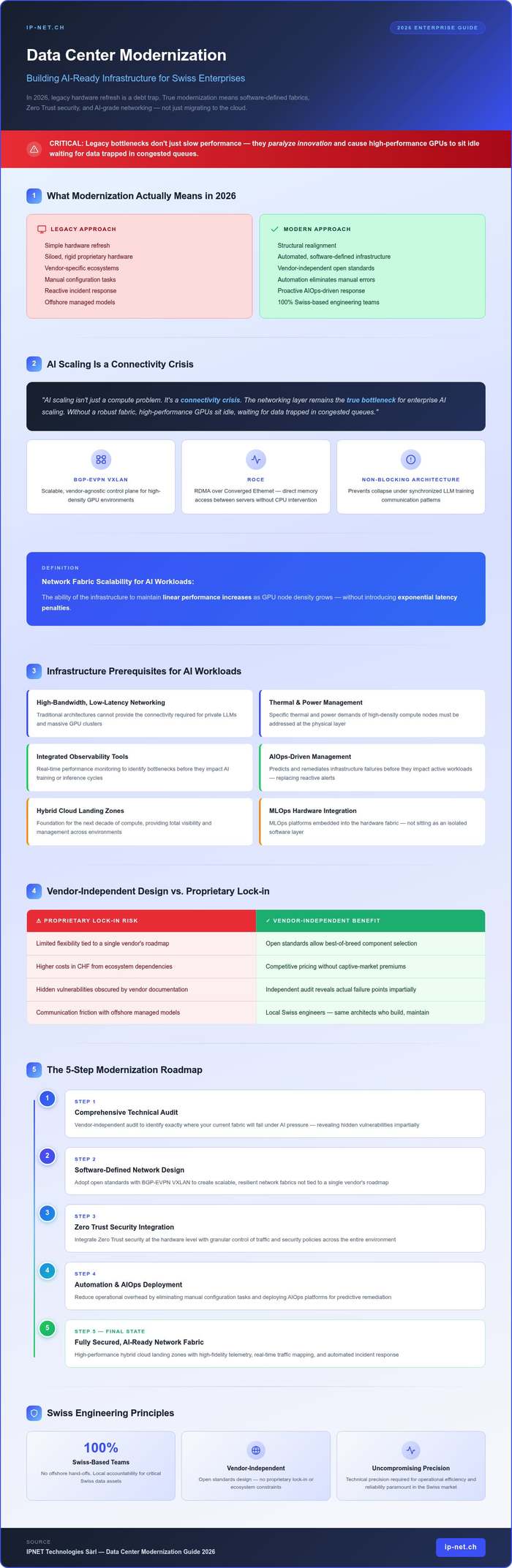
In 2026, a simple hardware refresh is no longer a modernization strategy; it’s a legacy debt trap. For many Swiss enterprises, the attempt to scale AI workloads on traditional networking stacks has revealed a hard truth: legacy bottlenecks don’t just slow down performance, they paralyze innovation. You’ve likely realized that your current infrastructure wasn’t built for the high-density, low-latency demands of the modern era. Utilizing expert data center modernization services is no longer an optional upgrade but a structural necessity for maintaining competitive agility.
We understand the frustration of being tethered to vendor-specific ecosystems that limit your flexibility and drive up costs in CHF. This article demonstrates how to transform these legacy constraints into high-performance, AI-ready environments through uncompromising Swiss engineering and vendor-independent design. We’ll explore the transition to automated network fabrics, the integration of Zero Trust security at the hardware level, and a clear roadmap for your 2026 infrastructure.
Key Takeaways
- Transition from siloed legacy hardware to automated, software-defined infrastructure to support high-performance hybrid cloud landing zones.
- Identify why the networking layer is the primary bottleneck for enterprise AI and how to architect GPU cluster fabrics that eliminate congestion.
- Mitigate strategic risk by utilizing vendor-independent data center modernization services to reveal hidden vulnerabilities and avoid proprietary lock-in.
- Leverage a structured five-step framework to move from a comprehensive technical audit to a fully secured, AI-ready network fabric.
- Ensure long-term structural integrity and local accountability through 100% Swiss-based engineering teams without offshore hand-offs.
Table of Contents
- Defining Data Center Modernization Services in 2026
- Architecting for AI: The Network Fabric Core
- Vendor-Independent Design vs. Proprietary Lock-in
- Executing the Modernization Roadmap: A 5-Step Framework
- IPNET: Uncompromising Swiss Engineering for Data Centers
Defining Data Center Modernization Services in 2026
In 2026, data center modernization is no longer synonymous with a simple migration to the public cloud. It represents a fundamental structural realignment. This transition moves organizations away from siloed, rigid hardware toward automated, software-defined infrastructure that functions as a single, cohesive unit. Comprehensive data center modernization services now focus on building the foundation for the next decade of compute: hybrid cloud landing zones and AIOps-driven management systems that provide total visibility.
For Swiss enterprises, this evolution carries a specific requirement for local accountability. The shift toward complex, high-performance environments has made offshore managed models increasingly risky. Local engineering teams provide the direct responsibility and technical precision required to manage critical Swiss data assets. This avoids the communication friction and security concerns associated with international hand-offs, ensuring that the architects of the system are the same experts who maintain it.
The Shift from Legacy to Software-Defined
Breaking the cycle of proprietary hardware lock-in is the first step toward true agility. By adopting open standards and implementing BGP-EVPN VXLAN, organizations create scalable, resilient network fabrics that aren’t tied to a single vendor’s roadmap. This software-defined approach allows for the granular control of traffic and security policies across the entire environment. Automation plays a central role here. It reduces operational overhead by eliminating manual configuration tasks, which significantly lowers the risk of human error during complex migrations and daily operations.
Infrastructure Prerequisites for AI Workloads
The 2026 landscape is dominated by the need to support private Large Language Models (LLMs) and massive GPU clusters. These workloads demand high-bandwidth, low-latency networking that traditional architectures simply cannot provide. Modern data center modernization services must address the specific thermal and power demands of these high-density compute nodes. Beyond physical power, the logical layer requires integrated observability tools. Real-time performance monitoring ensures that bottlenecks are identified before they impact the training or inference cycles of enterprise AI platforms. This level of technical depth ensures the data center isn’t just modernized, it’s structurally prepared for the AI era.
Architecting for AI: The Network Fabric Core
AI scaling isn’t just a compute problem. It’s a connectivity crisis. While many focus on power and cooling, the networking layer remains the true bottleneck for enterprise AI scaling. Without a robust fabric, high-performance GPUs sit idle, waiting for data that’s trapped in congested queues. Effective data center modernization services prioritize the elimination of these tail latencies to ensure maximum return on hardware investment. In the Swiss market, where operational efficiency and reliability are paramount, this technical precision is the difference between a functional platform and an expensive failure.
Eliminating Bottlenecks in GPU Clusters
Designing for AI requires a shift to non-blocking architectures. Traditional oversubscribed networks collapse under the synchronized communication patterns of distributed Large Language Model (LLM) training. Implementing RDMA over Converged Ethernet (RoCE) is essential. It allows for direct memory access between servers without CPU intervention, slashing latency and reducing overhead. We utilize BGP-EVPN VXLAN to provide the scalable control plane required for these high-density environments. This standard ensures that your fabric remains vendor-agnostic and resilient. Network fabric scalability for AI workloads is the ability of the infrastructure to maintain linear performance increases as GPU node density grows without introducing exponential latency penalties.
Observability and AIOps Integration
Proactive observability replaces the reactive cycle. In a modern data center, you can’t wait for a performance degradation to trigger an alert. Utilizing AIOps platforms allows engineering teams to predict and remediate infrastructure failures before they impact active workloads. High-fidelity network telemetry provides the granular visibility needed to map traffic patterns across the fabric in real time. This level of insight allows for automated incident response that maintains the structural integrity of the system. This ensures MLOps platforms are deeply embedded into the hardware fabric rather than sitting as an isolated software layer. If you’re planning a transition, a vendor-independent technical audit identifies exactly where your current fabric will fail under AI pressure.
Vendor-Independent Design vs. Proprietary Lock-in
Relying on a single vendor for critical enterprise infrastructure creates a strategic vulnerability that many organizations don’t fully appreciate until a refresh cycle begins. Proprietary ecosystems often masquerade as “unified solutions,” but they frequently result in technical debt and inflated renewal costs in CHF. Professional data center modernization services must prioritize architectural independence to ensure long-term viability. When you’re tied to a single vendor’s lifecycle, their roadmap becomes your limitation, often forcing upgrades that don’t align with your specific business requirements.
A vendor-independent technical audit is the first step toward reclaiming control of your stack. These assessments reveal where proprietary protocols have created “black boxes” in your network. By identifying these bottlenecks, Swiss enterprises can transition to best-of-breed technologies that offer superior performance for specific workloads, such as AI clusters or high-density campus networking. This Swiss-engineered approach demands technology selection based on empirical performance data rather than marketing alliances. It ensures that the hybrid cloud landing zones you build today remain compatible with the innovations of tomorrow.
The Freedom of Open Infrastructure Standards
Leveraging open-source protocols like BGP and VXLAN ensures the underlying fabric remains flexible. It’s about breaking the link between the software control plane and the hardware chassis. This separation allows for more competitive vendor selection during the refresh cycle, significantly reducing the Total Cost of Ownership (TCO). You aren’t just buying hardware; you’re investing in an architecture. A consistent security posture is maintained because policies are defined at the structural level, not dictated by a specific manufacturer’s feature set. This independence allows for the seamless integration of multi-vendor environments that function as a single, high-performance unit.
Zero Trust Architecture at the Core
Security is no longer a perimeter add-on. In a modernized environment, Zero Trust is integrated directly into the data center fabric. This allows for granular micro-segmentation that contains the lateral movement of threats within the internal network. By implementing SASE (Secure Access Service Edge), organizations extend this secure environment to remote resources. This ensures access to sensitive internal applications is strictly controlled and verified, regardless of where the user is located. This structural security model protects your data assets at the hardware level, providing a level of resilience that software-only solutions can’t match.
Executing the Modernization Roadmap: A 5-Step Framework
Successful infrastructure transformation requires more than just technical skill. It demands a methodical approach that balances current operational stability with future-ready scalability. Organizations often fail when they treat migration as a simple lift and shift exercise. High-performance data center modernization services provide the structured framework necessary to navigate these complexities without compromising mission-critical uptime. This roadmap ensures that every layer of the stack, from the physical cabling to the AIOps management layer, is optimized for the AI era.
- Step 1: Technical Audit and AI-Readiness Assessment. We baseline your current environment to identify technical debt and performance bottlenecks.
- Step 2: Strategic Design of the Fabric. We architect a software-defined network and security layer based on open standards.
- Step 3: Staged Migration Planning. This phase focuses on risk mitigation to ensure zero downtime for legacy applications.
- Step 4: Automation and Observability Deployment. We integrate the tools required for real-time telemetry and automated lifecycle management.
- Step 5: Transition to Managed AIOps. We move the environment into a state of 24/7 proactive operations and continuous optimization.
The Critical Role of the IT Audit
A granular technical audit is the foundation of structural integrity. We don’t just look at hardware specs; we map data flows to optimize hybrid cloud connectivity. This process identifies legacy bottlenecks that would otherwise cripple AI performance. A vendor-independent infrastructure audit is a comprehensive technical assessment of the existing network, compute, and security layers to identify performance gaps and proprietary dependencies that hinder scalability. This clarity allows for a design that addresses your specific requirements rather than following a vendor’s generic template.
Managing Complex Migrations
Bridging the gap between legacy systems and modern fabrics is a delicate engineering challenge. We use network virtualization to maintain connectivity during the transition, ensuring that data integrity is never compromised. This staged approach allows for the systematic movement of workloads without the risk of extended outages. Our 100% Swiss-based engineering teams provide direct, on-site accountability throughout the migration lifecycle. This local expertise is essential for resolving the unforeseen technical hurdles that often arise in complex enterprise environments. If you’re ready to begin your transition, you can schedule a technical consultation with our architects today.
IPNET: Uncompromising Swiss Engineering for Data Centers
IPNET Technologies Sàrl stands as a specialized systems integrator dedicated to the structural integrity of national enterprise infrastructure. Founded in 2006, our firm has spent two decades refining the methodologies required to navigate complex digital shifts with precision. While many data center modernization services rely on fragmented support models or offshore labor, we maintain a strictly national engineering presence. This ensures that the architects who design your high-performance fabric are the same experts who manage its daily operational lifecycle. We provide a direct bridge between legacy stability and the high-density compute demands of the 2026 landscape.
Direct Swiss Accountability
Direct Swiss accountability is the cornerstone of our operational philosophy. Swiss enterprises operate within a unique regulatory and data sovereignty environment that demands a partner with deep local roots. We eliminate the communication friction and security risks inherent in global support tiers. There are no offshore hand-offs; every engineer on our team is based within the country. This model builds long-term partnerships rooted in technical excellence and reliable incident response. It’s a level of commitment that global integrators simply cannot replicate for the Swiss market, where precision and reliability are mandatory.
Next Steps for Your Infrastructure
Positioning your infrastructure for the next decade of AI-driven growth requires a holistic view of the enterprise stack. We help you integrate SD-WAN deployment and enterprise campus networking into a unified architectural strategy. This ensures that the low-latency gains achieved in the data center are maintained across the entire network edge. To initiate an AI-readiness assessment, we perform a granular technical audit of your current environment to identify the specific path toward modernization. We then transition your systems to managed AIOps, providing proactive, 24/7 monitoring that identifies failures before they impact your MLOps platforms.
Modernizing your infrastructure is a strategic investment in your organization’s future agility. We provide the expertise needed to transform legacy silos into automated, vendor-independent environments that function with precision. Our focus remains on functional outcomes and technical excellence rather than making an easy sale. If you’re ready to secure your operational future and ensure your compute environment is an engine for innovation, we are prepared to lead the way. You can consult with our Swiss engineering team on your modernization strategy today to begin building an environment that scales with your ambition.
Architecting for Structural Integrity in the AI Era
The transition to high-performance infrastructure requires a fundamental shift in how we view the networking fabric. It’s about moving beyond legacy silos. We build resilient, automated environments that treat AI workloads as the standard, not the exception. By prioritizing vendor-independent design and software-defined architectures, your organization secures the agility needed to adapt as technologies evolve. Utilizing professional data center modernization services ensures that this transition is grounded in empirical performance data rather than proprietary marketing promises. IPNET brings over 20 years of infrastructure expertise to every project. We provide a 100% Swiss-based engineering team to ensure direct accountability and technical precision. Our role is to act as a trusted advisor, helping you navigate complex migrations while maintaining structural integrity. We don’t just deploy hardware; we architect future-ready environments. Architect your future-ready data center with IPNET Swiss engineering and build a foundation that scales with your ambition. Your infrastructure is the engine of your innovation, and it’s time to ensure it’s ready for the demands of 2026.
Frequently Asked Questions
What are the primary benefits of data center modernization services?
Modernization provides the structural agility required to deploy software-defined infrastructure and automated network fabrics. These data center modernization services eliminate legacy bottlenecks that restrict scaling. Organizations benefit from reduced operational overhead and the ability to integrate hybrid cloud landing zones seamlessly. By transitioning from siloed hardware to a unified, programmable environment, Swiss enterprises ensure their infrastructure remains a competitive asset rather than a source of technical debt.
How does modernizing a data center support AI and machine learning workloads?
Modernization addresses the specific high-density compute and low-latency networking requirements of GPU clusters. It involves implementing non-blocking architectures and RDMA over Converged Ethernet (RoCE) to ensure data moves at the speed of modern processors. This structural realignment prevents the networking layer from becoming a bottleneck during Large Language Model (LLM) training. It creates an environment where MLOps platforms can function with maximum efficiency and predictable performance.
What is the role of BGP-EVPN VXLAN in modern data center architecture?
BGP-EVPN VXLAN serves as the standardized control plane for scalable, resilient network fabrics. It allows for the creation of virtualized overlays on top of a physical underlay, providing granular control over traffic and security policies. This architecture ensures vendor independence by utilizing open standards rather than proprietary protocols. It’s the foundation for building automated environments that can scale across multiple data center locations while maintaining a consistent operational model.
Why is vendor independence important for enterprise infrastructure?
Vendor independence prevents proprietary lock-in and the associated inflation of renewal costs in CHF. It allows organizations to select best-of-breed technology for specific use cases, such as AI infrastructure or campus networking. By relying on open standards, enterprises maintain long-term architectural flexibility and can negotiate more competitive terms during refresh cycles. This approach ensures that your infrastructure roadmap is dictated by your business requirements rather than a single manufacturer’s product lifecycle.
How much does a data center modernization project typically cost?
The cost of a modernization project depends on the scale of the environment, the complexity of the migration, and the amount of existing technical debt. Factors such as the transition to high-performance GPU networking or the implementation of Zero Trust security layers also influence the investment. We recommend starting with a vendor-independent technical audit to identify specific requirements. This provides a clear roadmap and allows for accurate resource allocation based on your unique infrastructure goals.
What are the security implications of data center modernization?
Modernization integrates security directly into the hardware fabric through Zero Trust architecture and granular micro-segmentation. This model assumes no implicit trust, requiring verification for every connection and containing the lateral movement of threats. By integrating SASE, organizations extend this secure posture to remote access and branch locations. This structural approach protects critical Swiss data assets at the foundation, providing far greater resilience than traditional perimeter-based security solutions.
How does IPNET ensure zero downtime during a data center migration?
We utilize network virtualization and a meticulous five-step framework to bridge legacy and modern environments during the transition. This allows for the staged migration of mission-critical applications without disrupting active services. Our 100% Swiss-based engineering teams provide direct, on-site accountability to resolve technical hurdles in real time. By mapping data flows and testing configurations in parallel environments, we ensure data integrity and operational continuity throughout the entire data center modernization services lifecycle.
What is the difference between reactive monitoring and proactive AIOps?
Reactive monitoring relies on static thresholds and alerts that trigger after a performance degradation or failure has occurred. In contrast, proactive AIOps utilizes machine learning to analyze real-time telemetry and predict infrastructure issues before they impact workloads. This allows for automated remediation and continuous optimization of the network fabric. Transitioning to managed AIOps ensures 24/7 proactive operations, moving your engineering team from constant firefighting to strategic infrastructure development.
Leave a Reply